Navel Oranges, Granny Smith and other Genre Beasts

I recently was in a conversation about genre because a book, I had reviewed, was criticized for having claimed to be hard science fiction: although it clearly wasn't. That latter is not my statement although I would agree that there are elements that would cause me to think it leans away from most people's view of what hard science fiction is.
The problem came when someone tried to compare the ease of identifying hard science fiction with how someone might identify a sonnet, which struck me as a somewhat inaccurate comparison as it seemed to be comparing apples to oranges. The reason I say this is that a sonnet might better be compared to perhaps determining if something is a novel or novella or short story; because it's a matter of specifics that must occur to be named such, with some small wiggle room for style as perhaps regarding the scheme of the rhyme in a sonnet, of which it is interesting to note when translating from Italian to English becomes an effort in futility to retain the rhyme scheme.
Whereas: Genre are a bit slipperier than all of that in that there really is yet no industry standard. This means that even within the industry there are differences of opinion as to what constitutes a specific genre and even all the way to identifying the elements of style and content. I would guess that the only real need for specific guidelines beyond this would come to those organizations giving out prestigious awards to authors: they certainly should define the scope as well as possible: to make the judge's job easier. The problem comes when those in contact with such organizations try to turn back upon the system and impose those ideals into a system that has not yet shown a desire to standardized itself.
The lack of standardization means that the publishers definitions might not be the same as the book sellers or librarians. And that from country to country there may be some wide differences. This is likely the source of the fuel to the fire of controversy over what should be hard science fiction. Going into a bookstore I would usually find all of science fiction under the heading of science fiction and sometimes included under the heading of science fiction fantasy which mean that all the sub-genre are mixed willy nilly and the reader has to sort through to discern which is what.
In the discussion mentioned above one complaint was that a self publisher should regulate themselves to be able to discern that they are not hard science fiction thus not proclaiming such and yet in the same breath this person suggested this responsibility to discern might easily be overlooked or not apply to a traditional publisher, which was so many ways wrong and backwards.
The next suggestion I was given was that Hard science fiction would be fiction that limits itself to the law of physics. To this I would have to have added :as we know it, if I were to agree. I don't agree because that is too narrow and again that is why we have the controversy. One problem even with physics is such things as the controversy of quantum entanglement as regards to the possibility of violating the speed of light limitations. The suggestion here is that we lack some understanding of physics to fully explain some observable phenomenon- where do we put such things in our view of hard science fiction, if we dare extrapolate?
If what we have today were actually the sum of all knowledge what physics has to offer I would guess that we'd live in a much different world.
But hard science fiction is not just physics its technology and economy and politics which in some way seems to fly in the face of reason because of the want to put those three into something called soft science fiction.
We have made it to the moon, a fact: unless you subscribe to a fringe element. We haven't gone back recently because of economic factors regarding the cost of current technology to get us there and the political and economic barriers of obtaining the funds: problems which are now being remedied by private concerns finally taking a step into the arena. So, even if a person were to take only what we have now and were to write about a universe where we were in constant motion between here and the moon there would have to be plausible explanations of all the factors to get us there or it would likely fail the test of some definitions of hard science fiction.
Let's consider the work of Arthur C. Clarke whom I always thought of as a hard science fiction writer if any would be. Yet when we look closely at 2001 Space Odyssey we see elements of the monolith and the race that made them and the ending of the book and we see some departure from what many claim hard science fiction must be. Not withstanding the disappointment; that we have a far reach yet to obtain the level of intelligence in AI's that HAL possessed.
Even other favorites such as Issac Asimov and his Foundation series do not fully qualify to some high standards of hard science fiction and it grieves me so.
I recently read a novel that might have taken a lot of its science elements and acronyms right from such accounts as Apollo 13's fateful voyage. The author added some inexplicable parallel universe device creating a novel to which we could always say is of a new genre to avoid the controversy of hard science fiction: since all we do need is a few more sub-genre to place on the steaming heap.
The bottom line seems to be that genre are meant as a means of creating a listing to assist the readers in locating the type of books that they enjoy. Unless or until they standardize, the practice will at best have limited success, but it should serve the purpose it was intended for , which is to get the book placed before the most likely readers of that type of book, or you would expect the industry leaders would have already moved to standardize.
If a writer intends to win an award, though, he may want to begin to consider obsessing about reaching those somewhat elusive standards for hard science fiction. This will likely lead to a lot of sweating of bullets and probably hinder the creative process and I would wish them a lot of luck.
Hard Science Fiction is at best a slippery beast that often gets relegated below Science Fiction which usually contains all of the myriad SF sub-genre if the venue allows. Sometimes I have found SF under Speculative Fiction and sometimes it has its own slot. Sometimes it is mixed not just with fantasy but paranormal, horror, and even suspense thrillers. It all depends on the shelf space and rightly so since the retail usage of genre is meant to exist as a marketing tool.
Perhaps on the day that I discover all those navel oranges in with my Granny Smiths and count them all as one in the same, I will say ah ha and I will have learned what hard science fiction really is.
J.L. Dobias
As a matter of interest I've included these links on the subject. This is not an endorsement, agreement, or refutation: Just a random selection of sources.
Genre Fiction Rules
Genre categories agent query
Genre categories cuebon.com
Genre fiction categories WD
Library of Congress Genre Term List
Genre Category List
Dummies guide to genre lists
Big fat fiction genre lists
Hard vs Soft SF
Hard vs Soft SF@ asimovs.com
Hard sf on wiki
Genre fiction on wiki
Genre fiction vs literature
 A Columbus of Space by Garrett P. Serviss
My rating: 4 of 5 stars
Columbus of Space by Garrett P. Serviss
This is an interesting piece that seems to have been written before Edgar Rice Burroughs and Otis Adebert Kline wrote their famous Venus series. This is a trip to Venus on a craft that can travel a tremendous speed and is powered by something that sounds possibly nuclear. Another interesting thing, since this is written after H. Rider Haggard's She, is that the main female character is described as having a presence that reminds me of Ayesha from She. And though she is not quite as dangerous as Ayesha, Edmunds fixation on Ala and the wonders of Venus might lead the expedition into danger.
Edmund has come up with a process that taps what he calls inter-atomic energy and he applies it to a special car shaped like a boiler, that he has created to take him into space. In a fit of anger at their remarks about his work he takes his friends with him without their consent. It takes about two weeks to get to Venus and there's some neat calculations behind it all though the ship itself has some potential design flaws.
Because of the peculiar rotational aspects of Venus Edmund chooses to land on the darker side where he figures there should be no one living, since it would be too cold. But they find a race of somewhat intelligent ape like hominids whom Edmund is able to communicate with through Telepathy. Because of dense atmosphere speech on the planet is amplified and though the beings do speak, they only do so on rare occasions. Learning about these creatures or people, creates some tension; but the real adventure comes when they traverse to the warmer sunny side of Venus.
On the warmer side there are more human-like hominids who also communicate through telepathy much the same as the apelike beings, though Edmund theorizes these people have tapped some other aspects of the difference in atmospheric pressure and possibly have a strange sensitivity to color and sound that is pretty interesting. Eventually he creates a device that helps them hear as the Venusian's do and they explore the wonderful strange way the Venusian's commune with nature. Here they meet the friendly, intelligent and beautiful Ala; and Ingra, Ala's jealous and dangerous fiance.
Edmund knows that they are in constant danger and they should leave soon, but he puts it off both because of his desire to explore Venus and that he enjoys teaching Ala; who seems to have an insatiable curiosity.
But there is some other portending catastrophe ahead that he ignores.
If I have any qualms about the story it's that of the other characters traveling with Edmund, only Jack and the narrator, Peter, seem to really get involved while Henry seems to mostly be going along for the ride, though every so often he votes they should go home or at least try doing some less dangerous things.
As it turns out this is another Dying World novel and this fact could get our heroes killed. But beyond that there are plenty of other dangers from the inhabitants and our heroes own miss-understanding of customs.
This is once again an interesting Classic in SFF and though the author has credentials that would support his knowledge of the science, there are still some things that might have been questionable back when he wrote this and certainly have a rough time surviving even the most rigorous of suspension of disbelief. Still for those who like to examine the roots of the craft of writing SFF, this is one more steppingstone to add to the genre.
Though I didn't quite get as much enjoyment from this as I have from Edgar Rice Burroughs and Otis Adelbert Kline. there's still enough excitement to get me straight through to the end; and now I wonder if those other authors read any of Garrett Putman Serviss's work before they ventured onto Venus.
J.L. Dobias
View all my reviews
 The Outlaws of Mars by Otis Adelbert Kline
My rating: 5 of 5 stars
If I could put Kline in a bottle.
The Outlaws of Mars by Otis Adelbert Kline
Once more this is a book I read way back in my teens; and about the time that I was reading Edgar Rice Burroughs. An interesting story about these is that after Kline wrote his Venus stories, Edgar thought they were imitations of his Mars series and then Edgar wrote his own Venus series and then in retaliation Kline wrote two Mars stories. I'm not sure about that because the timeline of publication looks like Kline wrote his Mars books before Edgar wrote his Venus books. But it still makes for some lively discussion.
Where Burroughs wrote his early mars series in first person Kline chose to use a third person narrator to tell his stories. The stories back then are around 50K to 70K words so they are not long reads. The science once more is a bit dicey and even back when I read it the first time it required a bit of suspension if disbelief. And once again there is this striking love at first sight thing going. But the novel is relatively short and there just isn't the time for those long protracted slow brewing love stories. And the love is integral to these stories. This book is the second of the authors Mars series.
Jerry Morgan is at a crossroad in his life and is out to visit his uncle, Richard Morgan. Back then there were no cell phones and even landlines could be rare so Jerry expects that his visit will be a surprise. What he's not planning on is that he's the one that will be surprised. It doesn't appear that his uncle lives in the house he arrives at. When his uncle finally does arrive it seems as though he doesn't need cell phones because he might be telepathic. This is not too surprising when we later find that the ship that will take Jerry to Mars is powered be telekinetic power. Not only that but somehow it will take Jerry to a Mars of the past.
Jerry doesn't take much convincing, perhaps uncle Richard is taking advantage of his vulnerable condition, and within a short time they are preparing to send Jerry on an expedition to a far away place and time. It's all quite well planed out and the voyage doesn't seem to take much time, but there's a wrinkle when Jerry arrives and the expected person who will meet him is not there.
Jerry manages to stumble into a garden. Gardens are grown on rooftops of palace buildings. He meets the pretty young Martian woman and saves her from the jaws of a vicious beast. When he's taken prisoner for having murdered the Princess Junia's pet that begins the series of blunders he'll manage before his appointed tutor can teach him the language and customs. He takes well to the language, but customs are going to take some getting used to.
When someone tries to poison Jerry, he begins to believe it is Junia's cousin Thoor Novil who has displayed a dislike of him. Thoor's sister Nisha has a different yet still unhealthy interest in Jerry, who by now has fallen deeply in love with Junia and can’t be tempted. And when it is believed that Junia's hot headed brother has been murdered, Jerry becomes a prime suspect. Though Jerry knows who the real killer is he also knows that the knowledge could cause war between the Martians and chooses to keep it to himself. To save himself and keep the secret, he has to go on the run, where he will be taken by the outlaws of Mars and begin the rough road to self preservation and redemption in order to win the heart of Junia, who now believes Jerry killed her brother.
And once again the main plot seems to be that the hero, Jerry, will do anything to win the heart of the woman he's fallen in love with. And though the story could almost be called the Lawrence of Arabia of Mars; this element of a romance between people of diverse cultures driving the story changes the character inner motives enough to make that analogy very thin to nonexistent.
Though I admit I have not revisited this novel as much as all the Edgar Rice Burroughs Mars novels there are some elements of the story that have stuck with me enough that I always have fond memories of the story and when I do reread it I find it just as enjoyable as it was back in the Sixties.
While John Carter of Mars seems often to be a larger than life character, Jerry Morgan seems easier to identify with though if we broke them down further we'd probably see that the two are very much the same based on the final analysis about their motives within the stories.
This is one more of the great Classic SFF with that small window through which we can examine some of the strange cultural notions that were prevalent in the early nineteen hundreds into the first quarter of that century.
Though this time I read this in e-book form I once again recommend those sensitive to grammar and spelling problems should stick to the older hard copies. The e-books seem to be derived from an ocr version that has flaws and any latter attempts to clean erroneous scan problems were ineffective.
Recommended for those SFF fans interested in getting a glimpse of where some of it all started.
J.L. Dobias
View all my reviews
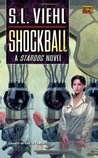 Shockball by S.L. Viehl
My rating: 5 of 5 stars
Shockball(A Stardoc Novel)by S.L. Viehl
Shockball is the forth in the series and has the most reveals for the ongoing threads. There still seem to be some loose threads and I haven't gotten far enough through the series to say yes or no to the rest being solved. This novel deals with Cherijo's dysfunctional family and probably the reason she has such a strange way of handling her relationships.
In this one; while trying to stay away from her father Duncan and Cherijo end up using the ship that was gifted to them by her father and it, of course, turns out to be a trap. But this is not before Cherijo apparently loses their baby because her body's strange chemistry rejects it. She's made a decision as regards the future of children and tries, throughout the whole book, to keep it a secret from Duncan.
Duncan and Cherijo are brought to Earth where her father tells her his insidious and somewhat creepy incestous plan. Duncan's future is being used as an inducement. But there is a secret underworld (like way underground) movement that breaks into her father's lab and generously help Cherijo and Duncan escape. It comes at a price when they are trapped below the ground and Cherijo becomes doctor to a bunch of hybrid Shockball players; while Duncan is enlisted on the team and continues as the inducement for Cherijo to stay there as a prisoner doing what the leader of these people wants.
Cherijo finds out that there were more children in her family; though most of them were destroyed by her father, as failures. There might be one still alive.
Each of these novels has come out in a similar format. They are all approximately 150k words and almost four hundred pages. I would almost guess that the others in the series might come out the same because it's beginning to look like some sort of pattern.
This novel is a great place to read to get most of the answers to all the burning questions and even a bit more information than one might want, about some few other things. A lot gets resolved and finally leaves the main characters in a better place. Even if there are still some warm questions hanging in the wings.
SSF for fans of the Sci-Fi type and those that like Romance and perhaps a bit twisted family stories.
I'm taking a slight break from them for now; though I do have Blade Dancer, which takes place in the same universe. These are excellent books for someone with a voracious appetite for reading SFF.
J.L. Dobias
View all my reviews
 A Princess of Mars by Edgar Rice Burroughs
My rating: 5 of 5 stars
A Princess of Mars by Edgar Rice Burroughs
I recall this book as being one of the most read books on my shelf, when I was a teen. Since then I’ve gotten it out every few years to further enjoy it. I've never really sat down to try to understand what it was that I like so much about the book ,or for that matter the whole series of books; so here I am again reading it just to see if I can uncover its secret and ultimately to enjoy it once more.
I have to say that reading Edgar Rice Burroughs is simply something I do for the pleasure of the read. The writing is simple and engaging and the main characters are always the chivalrous gentlemen and though there are some elements of the female characters that display strength; they generally are treated as secondary characters that must be protected by the main character.
These novels are written in that style of writing from way back when there had to be some new peril waiting for the hero: just around the corner. And truthfully that hasn't changed much. Told from an engaging first person point of view A Princess of Mars tells the story of a Virginian gentleman who, after serving in wartime, has tried to make his fortune looking for gold. This story takes place back in the old west in a time when there are still savages about; and when some of those overtake his partner, he comes too late to the rescue but has to do the honorable thing and retrieve his friends body and this leads to his discovery of a cave that contains some mystery.
It's this mystery that transfers him from Earth to Mars where there are fighting men, men of honor, mad men and all types of beasts but most of all there is the one woman in the universe that John Carter might fall in love with; almost at first sight.
The story starts with a prologue that might not work well in today’s market,; though I only say that because you don't see them like this these days. It does serve its purpose even if it starts a bit slow; in that it builds up a sense of mystery about this man John or Jack Carter. He’s a solitary brooding sort. A man: who, in some time past, was known to enjoy the playful company of children and had a playful spirit of his own.
And so one has to wonder at the story of what has changed him so.
The meat of the story is an engaging tale that John tells of his adventures in prospecting that led to his greatest adventure of all and to a place that would forever be stamped upon his heart as his home. John is constantly trying to paint himself as a normal man; yet throughout even the episode of the capture and death of his partner in mining, the reader gets the building impression of a man who doesn't turn from danger when there are other obligations. Regardless of his own admission to usually have the common sense to avoid danger when there is nothing at stake; we always see him as a man of action and honor. These are two things that he will need for his future.
In a way the world of Mars or Barsoom was made for a man like him. He arrives amongst the Tharks and though he is clearly not a red man of mars he otherwise looks like them and the Tharks take him prisoner. In the odd culture they have, though he's a prisoner, his ability to act is not so limited and this will be to his benefit later when the red Barsoomian Princess Dejah Thoris is taken prisoner and he comes to her defense without thought about consequences. But all of this is part of the world building as we will see since John must move up in rank while a prisoner of the Tharks, so that he may earn the respect of Sola, his keeper, and the cheiftain Tars Tarkas, one of the Tharks who captured him. Ultimately these twoTharks are destined to be his friends.
One qualm I might have with the story is the love at first sight between John and Dejah. Well maybe when I was a teen I might have accepted this as a given. But it moves the story along because the primary goal for John is to keep his beloved safe from all the peril around them. The love story does not go without several hitches, often caused by a lack of understanding of customs among the Martian peoples. But even as he blunders through those, John continues to make friends of even some who might be enemies of his friends and this is important to the story because he will use all of this to bring those close to him together in a diplomatic way that might never have occurred without his presence.
At every turn there is more peril and more to push a distance between him and the one he loves while sending him on further adventures that will ultimately lead to his final settlement of everything. Throughout all of this, despite what he does achieve, he makes it clear that his goal has been somewhat selfish, in that it is all designed to break down all barriers that might keep him and Dejah Thoris apart.
Yet in a certain form of creative irony the story moves forward best when Edgar Rice Burroughs thinks of the worst perils and stumbling blocks to place in Johns way, as he goes through the story, and though there are the quiet periods those are always punctuated by bursts of the fervent activity of fighting an uphill battle just to be together. And that is what happens for the first several novels in this series. One comes to feel great empathy for these two lovers and their plight to have a life together.
Overall this still is mostly a novel I read for the entertainment and that is helpful since the science has never been quite the king from the very start. Though there are some interesting concepts; such as the anti-gravity that keep the massive ships floating in air and the notion of a dying Mars whose atmosphere is being produced by a chemical and mechanical apparatus that is subject easily to any form of vandalism or catastrophe, leaving all the races to a slow death through hypoxia.
A Dystopic Dying Earth type of tale that is lightly veiled in a Science Fiction Fantasy adventure that is contemporary to many other such marvelous tales.
A recommended reading both for the pleasure and some nostalgic value with a slight window once again into the thoughts and attitudes of the early 1900s.
Another Classic SFF from one of my all time favorites.
J.L. Dobias
View all my reviews
 Darkness and Dawn by George Allan England
My rating: 5 of 5 stars
Darkness and Dawn by George Allan England(1877 – 1937)
Darkness and Dawn is a compellation of three novella by G. A. England, written from 1912 to 1914 and tells the story of two survivors of a Dying Earth type event that takes place around 1920 or somewhat eight to six years in the future of their publication. It's a well written story from its time and has the disadvantage of reflecting views and beliefs of that time; but sometimes I think opinion about that tends to be colored by overactive expectation. What I mean by that is there are accusations of it being specifically racist-(which it could well be)-based sometimes on erroneous interpretation (though I too could be erroneously interpreting things myself).
The problem stems from something that might be considered a spoiler; so there's the warning, though I don't think it will spoil the plot itself: only expectations. There are a number of questions that crop up in the story that get bandied about and never really get solved: from the readers point of view.
I love the way the story starts. Beatrice Kendrick, a young woman at work, awakes to find herself within the decimated ruins of her office. The story goes on to explain how even her typewriter has had the keys dissolve to dust. And this beginning almost gets the readers hope up, in that perhaps this is going to be about a strong female character. Don't get me wrong she does often come on strong, but once Allan Stern, her boss, enters the picture it seems to become his story. The point here though is that several mysteries are presented. One is that something catastrophic has happened and everyone else is gone and a long time has passed and somehow these two not only survive the disaster, but have slept through over a thousand years without aging. After this there are more mysteries such as the Horde which are some sort of Hominid aberration. And here is the spoiler: don't expect these mysteries to be solved. They are greatly speculated about by the characters, but the final answers are not really there: unless you want to subscribe to speculation.
The Horde is what often get mislabeled as the Racist part. And in part this is from the constant speculation going on from the admittedly uninformed Allan; at first referring to them as dark and upright walking like men. Later they are referred to as Hominids that, from description, sound closer related to apes with less fur and skin that is bluish gray. The parts I noticed that did seem racist don't get mentioned as often if at all by those reviews; but they are when Allan and the narrator voice keep referring to civilized man as being white. That declaration occurs far too many times to the annoying point of trying to drive something home; though I'm baffled as to what.(Perhaps just helping us get a grasp of the thinking of people in the early nineteen hundreds.)
As to the plot of the story; that seems to hover mostly in the area of the genre of dying earth stories. For me my earliest ventures in that genre might be H.G.Wells Time Machine. And in a way the Horde seem a lot like the Morlocks. But I could go back further to Le Dernier Homme (English: The Last Man) by Jean-Baptiste Cousin de Grainville and even The Last Man by Mary Shelley. We could jump forward to Philip Francis Nowlan and his Armageddon 2419 AD. It seems in all of these there is some catastrophe that ends most of life or at least civilization as we know it. This in a way seems a bit of a conceit in a couple of ways one of those being that we obliterate civilization and then find that it’s a man from the past who can help bring us forward again. Or that somehow the future generations are unable to survive the catastrophe and either all men die or they lose knowledge.
In this story the first novella, at the onset, I'm led to believe that all men have died and been replaced by the aberration that is the Horde; and the only hope for the future of mankind are these two inexplicable survivors. And still, there more mysteries. The Earth has rotated on its axis and there is a second object in the heavens besides the moon that is much closer to the earth and is always describe as being dark. These will be explained to some extent (As in somehow a chunk of the Earth blew into space and is now a satellite while the Earth shifted because of the catastrophe) but how they occur is never more than speculated upon by the survivors. Eventually more people are found; but they have devolved to somewhat primitive warring factions.(Well the technology has devolved.)
It falls upon our two Main Characters to bring civilization back to the Earth; though all things considered coming out of Allan's and the Narrator voice it seems that that civilization can only come out greatly flawed in ways that might be beyond Allan's comprehension. And though both Allan and Beatrice seem to be of high intelligence, they seem to stumble in and out of trouble because of overconfidence and carelessness.
The high adventure in the story is written much similar to the style of Edgar Rice Burrough's A Princess of Mars and Barsoomian novels that run contemporary to these novels. And I could even put those novels in the same genre though technically they are Dying Mars (maybe Dying Planet).
Another Great SFF Classic in the Dying Earth tradition, just be mindful that many of the most intriguing questions are left up for the reader to decide which interpretation or speculation might apply: if any.
George Allan England seems to love long sentences. I'm quite fond of them also; so that's a good thing.
In the first novel he has this one:
For of the room which she remembered, which had been her last sight when (so long, so very long, ago) her eyes had closed with that sudden and unconquerable drowsiness, of that room, I say, remained only walls, ceiling, floor of rust-red steel and crumbling cement.
England, George Allan (2012-05-17). Darkness and Dawn (Kindle Locations 44-46). . Kindle Edition.
:And this does an adequate job of describing conditions
But in the next two there are these at the very beginning:
A thousand years of darkness and decay! A thousand years of blight, brutality, and atavism; of Nature overwhelming all man's work, of crumbling cities and of forgotten civilization, of stupefaction, of death! A thousand years of night!
England, George Allan (2012-05-17). Darkness and Dawn (Kindle Locations 1842-1843). . Kindle Edition
Life! Life again, and light, the sun and the fresh winds of heaven, the perfect azure of a June sky, the perfume of the passionate red blooms along the lips of the chasm, the full-throated song of hidden birds within the wood to eastward--life, beauty, love--such, the sunrise hour when Allan and the girl once more stood side by side in the outer world, delivered from the perils of the black Abyss.
England, George Allan (2012-05-17). Darkness and Dawn (Kindle Locations 4965-4968). . Kindle Edition
:Both are quite flowery, but the first (for the second novella) I found quite compelling; whereas the second (for novella three) seemed almost over the top. And he has many more of these gems.
J.L. Dobias
View all my reviews
 People Of The Tiger: USA Edition - Book One of The Rational Future Trilogy by Wayne Edward Clarke
My rating: 5 of 5 stars
People Of The Tiger (The Rational Future Series) by Wayne Edward Clarke
I wanted to revisit this work after reading three classic SFF dealing with the Ubermensch and because this book has a very similar theme within it I got to thinking about how I managed to under rate it because of what I felt could well be offensive content. It is not so much that I have changed my mind; but rather I have opened it to the notion that someone of the Ubermensh might not be easily compared to a normal 6 or 8 year old.
Yet some of what I said back then should stand as a warning.
That much said we should address some simple issues.
This book contains erotica, and I have the modified version that might contain less. It's not chock full of erotica, but the erotica seems to puddle in places rather than being strung out. It's not particularly the best erotica I've seen, but perhaps that's because it's been altered because of complaints. On the other hand it is the closest to illegal that I've ever encountered. By illegal I mean that it contains the presence of children within the context and if this were to ever be made into a film it would violate some stringent rules.
To address this issue I'll give the author this much. The premise of the story is that we are in the future where Rationalists have dominated and created a new order. I'm of the impression this new order pervades the globe. In the story we seem to be in India-primarily. These rationalist are apparently not an outgrowth of Rationalism as much as they are perhaps a mix of Pot smoking free love hippies with aboriginal tenancies. Unlike most distopia novels these people seem to be an outgrowth of the former technological society that never lost the advances but have chosen to segment peoples into various classes all of whom have access to the technology but some who eschew it more than others. Hence, the various peoples with names of animals as their tribal designation. The green people, the naturalists have all gone back to nature.
The story begins with Tika and her mother Tira. It is Tika's sixth birthday and she moves from Infant to Training Child. It seems that Infants are brought up to whatever level they might endure in fighting and hunting arts but only become Training Child when they are ready to accept responsibility. Tika is not your average child nor are most of the children of the People of the Tiger. This is never made clear and it weakens much of premise for how the author treats them. My best guess is that at this age they are equal to someone who is roughly thirteen through seventeen in our society. That does not even cover the notion that Tika is genetically above the rest. This seems to be the reason the author wants to treat these children like young adults.
If they were all genetically engineered to be more mature then this would hold well in this story. Unfortunately another premise in this book states that they eschew genetic engineering and whatever was done to Tika is, in fact, considered illegal. These two notions create a moral conflict for at least this reader when the highly explicit sexual situations are brought into the story right into the face of these children. There is a play by play description and narration by an Elder while the scene itself plays out. Though the author attempts to keep it in an almost clinical sense, its this detached sense that is part of what destroys those scenes.(Too mechanical)
The author cleverly tries to tie the erotica into the whole book by way of explaining the rape that led to the birth of Tika, which is revealed in front of the children and then perhaps, trying to diffuse the emotional impact, by giving the children a contrast to the rape through other intimacy.(I'd say true intimacy but there's a problem here.)
There is no real intimacy involved in the erotic scenes,(well I wasn't feeling it) which is detrimental to the character development and the believable nature of the love part of the free love aspect. This all contrasts also to the gruesome nature of these people who will seem so intimate and yet in a similar clinical sense will do great bodily damage to each other in their fighting arena. (These people are the master of the disconnect.)
I loved the story of Tika and where she came from(the mystery) and the en-devour of her friends to find the answer to that question. For me the story and the conflict was the notion that until we know what happened to Tika's father we don't know what will happen to Tika. Tika is the strongest character draw in this novel she is the central character.
The first part of this novel does have some distracting philosophical notions.
[QUOTE]
but enough that over millions of years all people will become a little better because a few fools were killed by their own stupidity before they could breed.
Because we hunt for a living rather than for sport, we tend to make our work easier by hunting the weak and the slow, as other predators do, leaving the swift and the mighty to improve their breed.
and we also allow the tiny chance that the weak and the slow and the stupid among us will be hunted by predators.[/QUOTE]
Clarke, Wayne Edward (2012-02-02). People Of The Tiger - Metric Pro. Edition (The Rational Future Series) (Kindle Locations 259-260). Wayne Edward Clarke Publishing. Kindle Edition.
I don't particularly agree with these but it's primary to the novel that the characters do.
It espouses the back to nature part, but it fails to truly justify the running around naked in the forest full of dangers and predators. Most distopia novels at least try to pretend we lost some civilization and just don't know better.
The book spends a lot of time developing the tier system for honors for the people and basically coming up with the reason that they have to constantly challenge each other to duels.
I had a few troubles with the whole concept of going so backwards in time that they were challenging each other for their land, which technically didn't belong to anyone anyway. There is a portion where our hero and her family displace people for their own selfish purpose and that even leads to the death of a neighbor who eventually we try to justify by painting them in a pale light while they are supposedly expected to honor them.
There's a lot of emphasis on honor and it constantly runs contrary to the need to be truthful and the need to display pride publicly. The characters run through these like they might run through water and I can only think they need a therapist.
All this is building to the lengthy overdrawn out knife and claw and hand to hand fighting that goes with their Olympic like challenges. Again it would work better if these people were genetically altered to be better because no matter how close we bring the medical staff to the fight, these people do serious damage and should be killing each other.
I enjoyed more the pursuit of Tika's past and the building of the potential for some sort of faster than light travel which will possibly help Tika in her search for the truth.
If you like Sci-Fi and Fantasy and don't mind delving into odd sociological restructuring, you might be tempted to test drive this one to decide if you want to purchase the next in the series.
Despite some of my own misgivings in regards to what I felt were shortcomings, I found enough to enjoy with this that I read it completely.
I like a challenge and I don't mind leaving my comfort zone for a minute. So this has offered me some room for thought with People of the Tiger as I try to look at the way all these elements are woven together and decide how much seemed totally necessary to the story.
A person needs to read this to make a proper judgement and this would make a hot topic for someones reading group.
J.L. Dobias
View all my reviews


