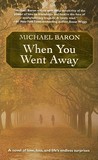
 When You Went Away by Michael Baron
My rating: 4 of 5 stars
When You Went Away by Michael Baron
Taking another break from my usual SF fare and my target has been sitting quietly in my kindle for two years. One more time I looked and asked myself what this one was doing here. So of course I started reading it; and kept right on reading it to the end.
I don't mind Nicholas Sparks and I've recently read The Fault in Our Stars by John Green. But this book nailed some of the feeling of hopelessness and despair, midst the driving pressure to keep sane while trying to raise a child alone. Add to this that his teen aged daughter had run away, just prior to the babies arrival and his wife’s death, and you've go someone who has little time and less inclination to be out looking for companionship.
This book adds an interesting touch in that his wife’s sister visits a lot. She looks just like her sister, his wife, and that can't be helpful. After taking time off to try to put the remains of his life back together, we find Gerry having a difficult time letting go enough to find a reasonable babysitter. But he knows he must get back to work; and he's buried himself for such a long time raising his infant son Reese that he may not have allowed himself enough time to grieve.
To add to this, when Gerry returns to work, he finds himself attracted to someone who seems so perfect; her only fault is that she's not his deceased wife and it's too early for him to start dating. Neither being too stoic nor to soppy his ruminations seem quite genuine as he tries to sort through his life. The only oasis he has is his son who remains forever his reason for continuing on. His daughter’s occasional emails, to let him know she is alright, have a dual effect: especially since she uses a forwarding agent that prevents him from locating her. He tries to sort through his life to figure out why she ran off with a boy three years older than her and vowed never to return. He blames himself.
Anger over his daughters estrangement and guilt over having feelings for someone else so soon and fear of forging ahead in life without his one true love; he's a powder keg waiting to be sparked to life. When something happens to his one anchor in life, Reese, blind rage might undo the work he started when he chose to return to his life.
There are a lot of things I can relate to in this book and it's well done and quite a compelling read for someone who expects different fiction and conflict.
Excellent Dramatic Romance, for someone taking a break from the usual; and just as great for someone who loves a good Romance.
J.L. Dobias
View all my reviews
 The Refugee Sentinel by Harrison Hayes
My rating: 4 of 5 stars
The Refugee Sentinel by Harrison Hayes
The year is 2052 population has outgrown the earth the polar caps are melting and the people who are considered to be High-Potentials are the only people deemed of any value to the future. When world governments come up with a lottery like system to reduce the population things begin to happen in the background that are subtle nudges toward trying to affect at least one of the High-Potentials. This novel has a lot going for it; but it will be taking you out of your comfort zone, which is never a bad thing. This time though this one takes the reader into the strange world of the antagonist (hit woman); and had there been any reason for us to even remotely want to have compassion for that character it might have been compelling. Unfortunately in this story there is little reason to feel anything for the trained hit person and I'm confused as to why we need to see so much of their training; since that entire thread distracts the reader from the real story: I think.
This is a well written story; but one of those that likes to time travel through back-story to get us to the day of greatest interest. Li-Mei, the hit woman, has a horrible past. Taken from her parents at a young age and trained to be an instrument of death. Now she is out in the world meting out death and destruction one step ahead of the lottery. She's been trained to be a heartless killer.
Colton Parker is a loser. The estranged husband of a High-Potential, Sarah, and father to an eight year old girl named Yana; Colton is going to find himself the center of attention from two directions. Each agency focused on him wants to see him dead.
This is the year that everyone must earmark each other for death. They can't earmark High-Potentials, so Sarah is safe; but some faceless person presumably working for a government wants to disrupt Sarah's life and earmarks her daughter Yana. The law says that someone might volunteer to take the death sentence from Yana and Sarah is hoping her estranged husband can be shamed into doing that.
For the mysterious evil plan to succeed the unknown agency must make sure that Colton Parker does not live long enough to save his daughter.
There is a reason behind his whole plan; and the entire concept of the lottery to reduce the population and having it go awry is enough to keep the reader in the story. The description of what Li-Mei goes through for her training is a bit disturbing and for me added little to the story. Perhaps if she could have been portrayed as some sort of hero, having to make a sacrifice at the end, it may have justified a need to show her back-story. As it is accomplishing her mission never really took much more from her than to be of cold-blooded murderous intent. Since the trail of bodies she was leaving showed that well enough, I didn't feel I needed to know much more than that she was a contract killer. Perhaps for me it didn't delve enough into her emotionally. I have enjoyed books such a those written by Trevanian where the protagonist might be a hit man for hire who has a set value system that's being challenged by the more egregious elements of the business and must decide how much they need to sacrifice and how far they will be pushed before they push back. I didn't see that here.
Perhaps, as often is the case, that's just me. There might be a lot of people who love to understand what made the cold-blooded killer the way they are. I felt it distracted from the purpose of this story; if the story was to be mostly about Colton Parker's willingness and capability of making a sacrifice. That back-story is well told and demonstrates the challenge behind that decision.
This is a Mystery Suspense Thriller Dystopia that should hold the interest of Thriller fans and maybe even those who like to dwell in the mind of the cold-blooded person who dogs the multi-flawed protagonist.
J.L. Dobias
View all my reviews
Bad Book Covers: Gypsies: Self-Publishing: A modern fable

It was just a book. It had, no flashy cover; no jacket at all and was somewhere between hard and soft bound. The one thing it had going for it was it had the sweet smell of leather, though I wasn't all that certain what animal hide was stretched over it. And the cover was not black; maybe grey, with dark lettering that was almost discernible. It was a bit worn. I had no idea why I kept it; but it was one of those small books, like the New Testament ones, some of those churches handed out. I'd pulled it out again, never really tempted to open it.
Once again I'd let my eyes focus and then go bleary; if I did this enough I could just read the lettering; the evening dusk wasn't helping. It said, 'Don't Mind Me'. And just below 'Anon', well it looked more like Anun: in it's worn condition. I'd never thought it was really A nun. I'd stifled the laugh and ended up chortling. I ran my finger along the binding and then in the channel between covers to feel the paper. The book was small and the pages looked a bit like onion paper, so it could still have the reality of a lengthy tome.
With it in my palm I'd slipped my thumb away from one of the covers and the softness had made the thing buckle just a bit and enough to flip the pages. It had opened to the title page which read, 'Don't Mind Me: I'm just your life'. It made me laugh, out loud.
I'd gotten the book from a gypsy palm reader at the traveling show; after she'd tried to read my lifeline on my palm and had gone to sleep. I should have known something was up, but I was waiting for her to say something; and when the big fellow from outside barged in, it had startled her awake: but the damage was done. Apparently something was way off, if my lifeline could put her to sleep; but no one was talking, they just wanted me to travel as far from their show as I could get.
It was while I ducked back through the beads and lace to relieve the line of customers that the gypsy pawned the book off to me. "Here kid you need this." I asked her what it was and she said, "A blessing and a curse." I told her she could keep her blessing and she shook her head. "You need the curse." That was the first time I'd looked at the book and I'd squinted the title into existence, before I'd stuffed it in my pocket.
What was that old saying about curses and making life interesting?
Well, if my lifeline had made her fall to sleep, I guess I could use some interesting in there. As I walked away with the large man stalking behind, I guessed he was there to make certain I followed their advice, I'd kept pulling the book out of my pocket: maybe to smell the leather.
Thoughts about my life; and the truth behind it all being quite boring, had given me pause as I reflected on the book and mused over the thought that I need a new author. I flipped more pages, each consecutive one was blank. I looked up to scan the outline of tents under a fog of colorful glowing lights and tried to ignore the presence of my watchdog.
I smiled: folded and stuffed the book back in my pocket: looked as though I'd get to write my own story: now.
J.L. Dobias - May 2015
 Atlantida by Pierre Benoît
My rating: 4 of 5 stars
Atlantida by Pierre Benoît
Even though this is a bit average in a classic; I enjoyed reading it.
It reminded me of those old Tarzan movies.
What it is though; is more of an example of the old Trope about the beautiful, seductive, feminine character whom the protagonists all fall in love with (sometimes inexplicably).
It seems there was some argument that Pierre plagiarized this from H.R. Haggard's SHE.
Though it does use a similar template of lost world and has Africa as a setting and the lovely irresistible woman as the centerpiece; the similarities end there.
Where She's Alesha, the centerpiece of H.R. Haggards story, is an almost tragic woman trapped in her own tragic love story; the centerpiece of Alantida, Antinea, is more of a sinister siren that would be almost a complete opposite to Alesha.
Alantida seems to lack the examination of morals and ethics that She has.
It's still an interesting read that once again gives the reader an examination of the views of woman and the affect on literature. But as I mentioned, it reads, to me, more like some of the movies I've seen from that time where the male characters are paralyzed under the influence of a hideously though beautiful and seductive evil.
I recommend this to anyone who has read SHE for the contrast and to those who have read this I'd recommend SHE for something with just a bit more substance.
J.L. Dobias
View all my reviews
Yes Virginia: Pure Science Fiction Can Entertain
I recently read a rant about how Science Fiction shouldn't have or need the Gee Wiz science that pervade the modern era of such writing. The author bemoaned that it appeared today's readers prefer the Wiz Bang to real science. They stated: those who write Science Fiction with real science are writing to an elite audience of readers. I have doubts about this.
It was a comment meant to make me think. It did just that. I look into what is being proposed and tried to match that with what I look for myself and I saw some patterns; but not the ones being touted. It seems more a matter of one being more entertaining than the other and there is no good reason that they both shouldn't entertain the reader.
We as authors can take all of the stuff of science today and fill the stories with only that, which fulfills the notion of writing what we know. That would truly be Science and Fiction or maybe even Fact - depending on whether we depict fictional characters or real people and historically recognizable stories. Science - recognizable today (with physics as we understand it today) - turned to Fiction with the what if- that is common to Science Fiction - adding fictional and believable characters into the what if of speculation.
This reminds me of the old discussion about Sci-Fi not being Science Fiction and perhaps the above would be one of the delineating elements. In the article I read this was one distinction the writer was trying to make, though he called Sci-Fi Skiffy, because of a bad connotation put upon Skiffy as they call it. I actually hate that word Skiffy; so I’ll use Sci-Fi for the remainder of this article.
The issue I take is that for a reader it’s difficult to find and for the writer to write an as if without extrapolating the Science to some itchy limit, which runs the author head on into a bucket load of Sci-Fi. I'm not saying that that is bad or even wrong because some of the things Jules Verne wrote about seemed pretty fantastic at the time he wrote them, yet today there are parallels to the technology he imagined and what we have. What is interesting with an old classic such as that is that Jules Verne put some well defined characters into the story with all that fantastical science.
I look at what I like to read in both Science Fiction and Fantasy and try to discern what works and what doesn't: for me. I look at what is strict science and what looks like Gee Wiz or Wiz Bang; and I rediscover something that rises above the discussion about science and physics that we know.
That would be simple good story telling.
When objecting to all the special effects and strange (over- extrapolated) notions that appear to go too far (which all may ring true), is the focus so narrow that the narrative that surrounds it escapes us in our frustration? What I mean by that is that we sometimes labor under the misconception that the fantastic what if and derivative science we extrapolate from present understanding is the only element of the story that is important enough to define its quality, while overlooking skill in narrative and the well crafted stories with strong character development. The error lies in the belief that the science is the story and it doesn't matter how well we write or who we put into the story as long as the science is stunningly accurate and sounds plausible. So when people buy the story with inexplicable science, some camps are baffled that these readers can rave about the whole thing. We dismiss the idea that a well written story with strong believable characters the reader can relate to might be enough for many readers.
This is not to say we can't have both, but it also doesn't say that the stories with Simon Pure science fiction always naturally contains the elements of good fiction writing.
What I like in my fiction is stories driven about characters.(I look at the cover-read the blurb in back-if possible I read the first chapter or ten pages- then I decide if I’ll like it.) For me: if there are no stunning characters then the science must fill that void with science that becomes the missing element of character. Then we might have something like Anne McCaffrey's Ship Who Sang or perhaps Clark's Hal from 2001 Space Odyssey. And we are still very far away from those types of Artificial Intelligence that they could both be considered extrapolations that stretch the readers suspension of disbelief too far.
Any author who has mastered the ability to place a believable, likable character into whatever situation will get my full attention every time. For me good solid science becomes added value. The science becomes less necessary for me to enjoy and relate to the characters. Too often I've found novels that are mired in the science while they are peopled with one dimensional characters who could be interchanged with anyone and not change the story.
This underlines the most difficult problem encountered by new authors when they get caught up in the notion that they have the greatest new idea for a plot and they try to run with that, keeping it secret so that no one else will steal the idea, and then end up wondering how their idea can't catch on when they finish the piece. They don't recognize that their 'story' is not that great science woven into some fantastic notion that may in many cases turn out to be some combination of old tried and true plots such as blending Frankenstein with Sherlock Holmes and mixing them with Victorian fashion in a novel driven by the wonders of Steampunk with a mix of vampires and werewolves.Well that might be pure fantasy. But the point is that the reader has to see the human element in all of this and understand what drives the main character's story as it intersects with the myriad of ideas sprouting out of the authors mind.
For me plot's and themes and gadgets and fantastic scenes don't drive the story. The plots and themes keep it under control and help shape the story. The lands and technology are a backdrop to help keep the characters from becoming talking heads; but they still are nothing more than the props. Though I will grant that sometimes they are well crafted props.
Characters are what drive the type of fiction that I like. Believable people the reader can relate to and become sympathetic with. Their struggle or conflict and all the pitfalls and obstacles put in their path and how they deal with all of that while growing or maturing right there on the page. How they deal with and react to the science. This often rubs shoulders with what some define as the soft science fiction; the stories dealing with social, political or psychological sciences. It is when the Simon Purist try to avoid those three that they run afoul; because that distancing caused by the avoidance often rips at the heart of the story that I'm looking for.
Both the Pure and the Sci-Fi with Wiz Bang have to be balanced with good writing that engages the reader and if the author becomes enamored with the science or the special effects to the detriment of good character development then the story is lost. When the reader puts down one to pick up the other it is not a deficiency in the reader it is rather a disconnect of the story from the reader. They may not be abandoning the Wiz Bang in favor of real science or vice versa; but they are abandoning poor writing for something that is well crafted that grabs their attention and keeps them riveted to their seat while pages flow by. And it just might happen that those well crafted characters are surrounded by gardens of Wiz Bang.
There is no doubt that Pure Science can enhance a story as do a new and fresh plot or scene. But these cannot replace a well crafted story; they are the icing on the cake. They are the gift wrap under which awaits the surprise that is the author's skill at his craft of telling the story.
J.L. Dobias
 She by H. Rider Haggard
My rating: 5 of 5 stars
She By Henry Rider Haggard.
I suppose, were I a scholar of those languages, the formatting might be a problem.
This is a great novel and a tremendous classic; but if I understood even a shred of Egyptian; Greek; or Latin, I might be as incensed as some others about the butchery of those parts of the book.(And once again we are looking at the e-book edition so one has to keep that in mind. As usual I would advise looking for a printed edition.)
As it is I thoroughly enjoyed the story and hope that there are not any plot points buried in the hashed up gobble-de-gook of old language. The standard form of prose from that era sometimes is enough struggle without having to consider the extra special effects.
I read She, in part, as a result of having had read Atlantida by Pierre Benoit; which someone had claimed was a major rip from She.
I find that argument to be quite thin upon examining both. To begin: I would like to say that Atlantida doesn't come anywhere close to being the intense classic that She is and such a claim might denigrate the work of Henry Ride Haggard. Atlantida differs considerably, so much so that such claims deserve only a shrug.
She, Ayesha, is liken to old Tropes in history and mythology and literature: amongst such greats as Aphrodite; Helen of Troy; Cleopatra; and Nefertiti-She finds her place. Women known for great beauty and seductive nature whom men will throw down kingdoms and fortunes to their very deaths, to stand beside. They have that certain something that draw men like moths to flame and probably today these types do not do so much in favor of helping the image of women. Yet it remains that these images are an excellent snapshot into the time from which they are drawn.
It would seem many key elements or threads that find their place in H.R.Haggard's She, later became the template for further lost world sub-genre and some of those elements end up in the dying earth or dying planet's genre of such greats as Edgar Rice Burroughs. So it might come as no surprise that Pierre Benoit may have borrowed elements when he wrote his Atlantida. It may even be argued that H.R. Haggard borrowed heavily from similar and more ancient tropes.
One point of interesting about She, is that there are mountains of exposition from one central character, Ayesha, that not only tell the backstory of her long life, but give insight into her philosophy and ideals about religion. Her arguments twist and sway the narrator who is also enthralled with her beauty and her very presence: often loosing a portion of his ability to argue rationally.
The narrator, Holly, is not a handsome man. He in fact is liken to a Baboon. But the orphan whom he has raised from childhood, Leo, perhaps has a handsomeness that could almost rival the beauty of She.
Of course this wouldn't be a story without the back-story of the family line of Leo. A back-story that may fatefully link Leo to Ayesha.
The story is written in that favored high and almost florid manner of prose of it's time; and might weigh heavy on the readers of this age, but I think it still stands well through time with a multilevel examination of several moral and ethical dilemma. Though it often seems that the narrator goes purple, the writing is strong and the story does not suffer.
Great Classic SFF that helps forge the way for further such adventure novels.
J.L. Dobias
View all my reviews
 Vortex Travelers: Sovereigns and Unwed Sailors by J.L. Holtz
My rating: 3 of 5 stars
Vortex Travelers: Sovereigns and Unwed Sailors by J.L. Holtz
This is definitely one of those novels that will fall in the love/hate category. I can see a quick division delineating those who forge on to finish the novel and those who fall quickly away from it. The stars could easily be well balance on this one and to that end I chose to place my two cents in the center as the fulcrum to the see-saw of reviews to follow. There are many things I love about this: one being the whole concept behind the plot; another is the sassy main character; and then there is the very fact I had to work to come to love it, which included having to finish it. There are some drawbacks and those tend to be the niggling bits that stand in the way toward possibly having someone throw the whole book down.(Which in this case is self defeating because it damages the kindle.)
The author is up front,
In her early explanations,
That her novel is written with a certain artistic flare: which makes it like a graphic novel; or a movie; or a piece of music. And it might well be that it often looks poetic, though there are certain elements rather lacking in the whole. Though if you look at what I did with this paragraph, you might have a small window into what to expect from what's inside this novel.
Add to that the interesting fact there are somewhere beyond six hundred colons used within and they outnumber the semi-colons but are dwarfed by the hyphens and dashes that are spread throughout. So with that in mind I think that it becomes clear, at least to me, why there might be some people putting this down after a sampling of pages proves that this condition is going to exist throughout. I wouldn't be surprised if some might suggest that this work needed a colon dash hyphen-ectomy.
But if you can get past that and the numerous grammatical problems, some of which one could wonder if they were errors or deliberate, then once settling down to where you know what to expect you have a better chance for enjoying the whole. The next hurdle for me was to sort out what was happening because of the next style choice, which seemed to me to be stream of consciousness writing. And this is not just from one character but primarily from two characters.
The story is part stream and part standard first person narration and the stream of consciousness is mostly present tense though there were some itchy moments in that that felt otherwise; and at first I had thought that the whole was going to be stream with present tense and standard first person narration in past tense; yet the whole thing started crossing boundaries (sometimes with good reason; other times not so much). Still as a whole this assessment might only be from out of my own perception; and I'd suggest when you read it you make your own judgment while possibly being ready for it; and then try to tough it out because the whole piece makes for an interesting literary attempt that poses as Science Fiction.
I do think that, with the right amount of editing, this could become good literary fiction. The problem with that might be that it would drive some editors mad until they began to find the pattern in the prose. For me though, this caused my reading comprehension to become very difficult and I was forced to slow my pace which always made the perceived errors stick out a bit more. But I forged on through and found that once I ignored the majority of the punctuation and the few other oddities I was able to focus on the story itself and though the science mixed with myth within the streams of conscious flowing off the page was often daunting: it often add; more than detracted from the story.
And though the story seems to be one of a teen named Lulu Wu and her struggle to focus while strange things start occurring around her and then moves into a potential for a love story with time travel and dimensional shifting. The real plot seems to be one more of the Universe trying to figure itself out. A universe formed from a big bang, which occurred when a godlike being was killed. And now the present universe faces destruction by a similar means which won't wait for this universe to find itself.
My stars on this one are meaningless-because I really loved most of the novel. But I think that the reader should be warned that it's not the usual novel and anyone wanting to read it should read the sample before purchasing it. I did that and still picked it up and there were moments I felt like putting the whole thing down. In the final analysis I'm glad I didn't.
And though some of the errors I found might be a part of the artsy-ness of the whole, I think there are a justified number of problems evident that this could use at least one good edit to pull it up and into the class of literary fiction where it belongs. There’s a lot of promise here in the future of this author.
I recommend this to all SFF fans (with caveats) and anyone who likes to delve in the literary end of the genre. A challenging read.
J.L. Dobias
View all my reviews

