Friday, June 2, 2017

Review::We Are Legion (We Are Bob) (Bobiverse, #1)We Are Many (Bobiverse, #2)By Dennis E. Tayler

We Are Legion (We Are Bob) (Bobiverse, #1)We Are Legion (We Are Bob) by Dennis E. Taylor

My rating: 5 of 5 stars

For We Are Many (Bobiverse, #2)For We Are Many by Dennis E. Taylor

My rating: 5 of 5 stars


We Are Legion (We Are Bob) & We are Many (Bobiverse, #1 & 2)By Dennis E. Taylor Book two adds so many Bobs and yet no two are alike and if there were any qualms about these books it might be that Bob seems so good we really haven't seen an evil iteration yet. Hmm perhaps....

The initial premise of the book is an intriguing look at something that people are doing today and possible ramifications in our future tomorrow. The whimsical look at a whim to live longer through cryogenic freezing. What happens when the world takes enough left turns that maybe you don't want to wake up to what's out there, not to mention that there may now be moral and ethical considerations that will prevent the original plan from being carried out.

What if the future deems you to be a non-person and possibly a source of technology--possibly old technology that might be tossed out or upgraded and put to use slaved to whatever task they deem necessary. That's not even mentioning the on/off switch.

Bob wakes up to a world of future advancements in things that could only be imagined and maybe a few that hadn't quite been imagined, to find that mankind has taken a few steps backward while heading into the future; and though there are interesting and bright horizons out there, he has to escape from humanities clutches to realize that.

I've purchased and read both books (the paperback editions). Going out on a limb with that purchase based on reading the book-one sample.

I was not disappointed.

Certainly they are many; however I might argue that they are not Bob.

I wasn't sure about that aspect, but having each Bob become something different and yet having throughout the story referential elements that were similar was quite entertaining and probably difficult to write.

However Dennis has great success there because it could have gotten confusing for a number of reason and yet it didn't and it may be despite of, and possibly because of the multiple number of short chapters and how well they are crafted.

I fully expected to get lost at some point and of course I couldn't read it all in one night. (One night--two books--that's my better half who might be able to do that.) So the small chapters were great, you could stop anywhere. However they were just short enough and each chapter's beginning and ending are crafted to make you turn the next page so it becomes--just a moment, next chapter, and I'll get ready for bed.

Yes there were some fantastical elements in both books, but the science and the various issues and what ifs were all pretty well crafted and didn't ever threaten to overwhelm the story itself which was basically how the character coped and evolved throughout the story.

Two thumbs up from all of us; we are many we are reader.

For anyone expecting something silly; you won't be disappointed, but you will get a huge bonus when you get hooked on this one.

J.L. Dobias


View all my reviews

Review::Blood War (The Healers of Meligna, Book 5) By K.J. Colt

Blood War (The Healers of Meligna, #5)Blood War by K.J. Colt

My rating: 5 of 5 stars


Blood War (The Healers of Meligna, Book 5) By K.J. Colt is the fifth of the series. A lot of series reach a point where they start stretching almost as though belaboring a point and threatening to be a never-ending story until readers start dropping out from sheer exhaustion. I have it from the highest authority that number six should put end to this series.

Now I just have to figure out if that's a good thing or a bad thing.

From the start we've watch Adenine grow from a seemingly tortured and abused child to something far greater than anyone might ask. And in her journey she certainly hasn't sought this out, well not in the manner that others before her have. We've watched her grow from someone pushed through life by a fate larger than her to someone who has decided to take life by scruff of its neck and give it a good shake before she examines and molds it into something far more acceptable.

And now she's reached the point where she's forced to do what she is most reluctant to do, wage war, because the consequences are beyond control.

This book opens with a scene that for some reason brought to mind Elizabeth Bear's All the Windwracked Stars. Maybe it's the notion of snow and the carnage of war with a contrast of white and blood and similar images. Though All the Windwracked Stars started mostly at the end of a battle, this book is still in the midst of battle; however the images are striking and vivid in both books.

For Adenine this is a tough battle and it is defining a length of dilemma that her own moral values have restricted and confined her. It's the crux of the story. As bodies fall she watches her own people putting arrows into friend and foe alike. This is all about the healing blood and how it has to be delivered to keep those who would otherwise perish from having to die. Her toughest goal though is to keep everyone alive, both friend and foe and in war that could be a fatal agenda and it certainly does not endear her to her own generals.

Just as she has done in previous books K.J. Colt examines some tough moral ground both in positive and negative directions and her main character is standing in the midst of those; challenging our ability to sympathize with her all of the time. It's not just the war--the conflict--but also it's her personal life and decisions, as she marches forward into battle carrying the children of one of her two lovers who are forced together at her side to fight this battle with her.

So with this fantastic beginning it would be a wonder if I mentioned that the story almost drags a bit at the beginning. I think that this is true of the first book in the series also. It's not an entirely bad thing and the first chapters make up for any slowdown in the next few; however there is a stage to set for this story and it takes a bit of time and as usual K.J. Colt manages to goad the reader with a bit of frustration with how Adenine is going about things.

Sometimes Adenine seems like her own worst enemy.

Things work out, but along the way Adenine has a number of lessons to learn and the most critical is one that we keep being remind of throughout and that is that you can't save everyone. However I've a feeling that Adenine is of the mind that she will die trying.

These stories can be read separately and give the reader a satisfyingly complete novel from front to back and usually enough background to keep the reader sane. However I would still advise anyone new to them to read them all.

Adenine is a wonderfully flawed and perfectly human character that constantly has to exceed her limits despite herself and it's difficult not to love her despite all the frustration she manages to put the reader through.

This is a must read for epic fantasy lovers and lovers of well built fantastic worlds.

J.L. Dobias


View all my reviews

Friday, May 12, 2017

Review::First Comes Duty (The Hope Island Chronicles-Book 2) By PJ Strebor

First Comes Duty (The Hope Island Chronicles Book 2)First Comes Duty by P.J. Strebor

My rating: 5 of 5 stars


First Comes Duty (The Hope Island Chronicles-Book 2) By PJ Strebor is a procedural science fiction with some element of military science fiction and political science fiction that might well rival David Weber's Harrington series. This is the second book in the series and I strongly recommend reading the first book Uncommon Purpose to get a full introduction to Nathan Telford and his strange story and somewhat strife-full beginnings.

I read this novel three times. I do that sometimes when I find something that was hard to swallow and I want to figure out just what it is. In this instance there were mitigating circumstances and nothing to be found or unraveled. The first read I believe was an ARC. The second I purchased the book when I was seeing double. That's not why I purchased it, it's just a medical condition. So because it's hard enough to read while seeing double, I didn't do a review. On the third time through the intent is to do the review with the whole thing fresh in my mind and I have to say I'm delighted I came back for a third look.

There are certain balances within the story that I really loved while there was at least one imbalance[in my perception]that became a bit annoying. The balance is the Military the political and the procedural. They all get about the same amount of focus throughout. The imbalance--for me--is that the bulk of the procedural is all in the front, making it hard to warm up to the whole novel. The only thing that drove that along were the myriad of interesting characters being set to it all with their own quirks and strengths and weaknesses.

The narrative is tight; despite the initial seeming endless procedural text. It takes a while to really get to the story but when it finally gets there the players are all introduced and the plot begins to thicken up and as a reader you begin to wonder how far things can go wrong and how many bodies will pile up on the way.

It is interesting to note that one thing I found intriguing was how the plot seemed to mirror the procedural in that everything that happens, whether it's something the characters have control over or the things that are going maddeningly wrong, fits into place with how the character either plans things or how they would logically react to them.

As with the previous story Nathan has his own set of quirks that sometimes work against him and sometimes are to his benefit. One of those comes narrowly close to creating his own internal deus ex machina. I'll just say that he has this talent that gets him out of tight spots. For the reader who dislikes those things this might begin to grind a bit because it's integral to the story.

The good news is he's not the only one with the talent so that means he isn't the chosen one. Or maybe I should say he isn't the only chosen one.

Did I mention there are plenty of strategic battles in the story to keep the reader interested. And narrow escapes for those characters who manage to make it to the end.

Each chapter has a timeline and location or setting note that I found I didn't need or read on the third time through. Again they are there for those interested though I'm not sure they add a lot to the story and it's clear enough that the average reader shouldn't get lost if he fails to follow the listed directions.

I think for anyone who loves the intrigue and politics of worlds like that of Honor Harrington, they should love these books. I'm looking forward to book three.

J.L. Dobias


View all my reviews
Monday, April 17, 2017

Review::Disconnected by Nick M. LLoyd

DisconnectedDisconnected by Nick M. Lloyd
My rating: 4 of 5 stars

Disconnected by Nick M. LLoyd might be considered a bio-thriller, though it falls more into the fantasy science fiction realm, but if one were more generous to stories about telepathy and mind control then we could call it science fiction; however that's putting the term loosely and overlooking the prejudice of some against Teeps in general. I picked this book because I'd already read the author's book Emergence, which I thoroughly enjoyed and it is closer to science fiction. Since it was LLoyd's writing that I enjoyed I thought this would be a fair bet even though it almost meandered outside my usual read. So as the story opened I thought bio-thriller. Not far into the story we are introduced to Asha and the mind control squad, which somehow simultaneously brought to mind AE Van Vogt's Slan and Greg Bear's Darwin's Radio. Though the mind control was tied closely with an herbal source of sorts it still almost portended some advancement in human evolution. The description of how the practitioners observed the world around them and the natural connection that all beings have seemed new to me so it added a bit of freshness to the story as I read along. However that also contributed with the one thing that began to drag the story down for me. The good news is that the drag is associated with my own preferences and I think people interested in like fiction should warm up to this story quickly.

The story begins with Sarah out in the steaming hot jungle searching for bonobos who may or may not be suffering from some sort of virus. The plot behind the virus is rather convoluted at first, though not hard to follow. Boiled down they are looking for a cure for dementia and hoping to find something that correlates within the bonobo population. However Sarah's boss Polly Wolfson will go to any lengths to procure test animals straight down to injecting them with a virus if she needs to. Sarah doesn't agree with this, however her relationship to Polly's son Marcus has momentarily trapped her into a moral dilemma that she has to unravel. And that is probably too much to say about the plot.

Asha and his acolytes are interested in politics and manipulating the local politicians. Using the magic pill made from a bark from trees that grow exclusively in one place in the jungle they are able to enter and manipulate the connections that all people have subconsciously developed between each other. The connection to Sarah and Polly is through the jungle because the place that Sarah is hunting is the same where the trees are and there is more depth to that portion of the plot that I shouldn't tell.

Politics and medical science are on the verge of colliding when all appearances indicate that these two organizations might have enough in common to attempt to help each other. The question is, when you have two high powered manipulators working end to end, who is working whom.

Now onto a few troubles I had that really boil down to my own preferences and I'm certain that there will be other readers who will find the work entirely satisfying. I love stories that focus on a character and I can live with shared focus up to a point. This story seems to hover about Sarah and Asha alternately until the two story-lines collide. However I felt the focus more on Asha than Sarah and yet when I reached the end I felt the story belonged mostly to Sarah and that confused me a bit.

When I look back I realize that part of that confusion lie in that the story spends a large amount of time explaining both the Bio-medical portions and the nature of the mind manipulations. It might be that my mind glazed over during the bio-medical parts while it focused better on the mind manipulation world building. Still there is a large portion of both, which again may suit a lot of other readers and it does help get a full sense of what is going on in the background of both worlds before they collide. However there is so much that it almost begs a sequel to the story (why spend that much resource on explaining so much otherwise).

Still overall for those who like the Bio-thrillers and books on mind control and all the secrets behind how they work in this world this book has a lot to offer and it's well written with some interesting and somewhat complex characters.

Overall a great read despite my own moments in trying to keep focused.

J.L. Dobias


View all my reviews

Wednesday, December 21, 2016

Review::Chronicles of Empire Gathering by Brian G Turner

Gathering (Chronicles of Empire 1)Gathering by Brian G. Turner

My rating: 5 of 5 stars


I picked the Chronicles of Empire Gathering by Brian G Turner up because it promised both Fantasy and Science Fiction with a taste of something--possibly of Historical Fiction. It doesn't disappoint in creating that combination and I have to admit that I truly enjoyed the story and the characters. But there were some elements that made this a difficult read for me and after finishing the first time through I had questions about things that I couldn't honestly say were not answered in the book because, as it turns out, on my second read through I discovered that I must have been thrown out of the story several times. Sometimes this can be the book and sometimes it can be the reader. I'm glad I read this through a second time, because once I made a pact with myself to pay better attention to what I was reading, most of the questions were answered.

It may be that some aren't because this is a series or it might be that I still missed a few things. I'll get into a few of those along the way here.

I think one problem in my first read was a feeling of slight disjointedness between the Science Fiction elements and the Historical Fiction element. It felt almost like the Science was overlaid on top of a Historical Fiction. Part of that might be the attention to detail paid toward the historical detail along with reasonable well written material concerning metal working. The metal work is integral to the story and certainly adds to it. Some other detail becomes somewhat questionable allowing in part some bit of wild speculation about the Science Fiction part.

By this I mean that from my understanding (and please understand I might have some of this confused even after two reads), this planet is not earth regardless of the fact that the wildlife and flora seem to parallel earth quite well. It would make for a nice parallel Earth story, except (again from my understanding) this world has some part to play in the making of our Earth. So-unless somewhere down the line we find that as it goes streaking through our solar system it somehow transports all of these element onto the earth (maybe likes James Blish's Cities in Flight) It just seems too much a coincidence to be so closely parallel.

So the science fiction part of the story involves two characters protagonist and antagonist. I had a difficult time deciding which was which.

Molric seeks to save the past of this planet; which seems destined to some catastrophe in the future where he comes from. Ezekial also comes from the future; but knowing that this planet's doom is imperative to Earth's existence he seeks to stop Molric.

But in the main story itself, which does in many ways remind me of the Three Musketeers with all the political and social intrigue, there are forces working against them both.

Rodrigan seems to represent an element of the religious order who are working with Molric (he is not aware exactly what Molric is other than a way to gain power over the empire and depose the emperor.) His motive could be good; but his methods sink any possibilities of putting him in a protagonist position.

The group that is gathering are ultimately working for the Emperor, who also would not qualify well as a protagonist. But primarily Jerine and her sister Tilirine seem intimately associated with some higher power and they are presently aligned with Ezekiel without knowledge of his past or even his goals.

There is a vast intrigue that seems to orbit these two primary groups of players and in some large way it gives the appearance of one group attempting to push back the tide of time; while the other tries to restore it; while all else conspires to let time march on as it always has.

Though the historical accuracy (of peoples; institutions; economy and politics and not actual history of ours) can for some readers (this one) often throw them out, it does add both a mood and a sense of world building that makes it quite authentic. Add to this the peopling of believable characters both flawed and sometimes downright frustrating; this is a well written book that deserves a good read and probably more attention than I gave it the first run through.

---Possible spoiler alert-though my obvious confusion might abrogate it.-----
I am however still confused about the future characters mentioning having seen this worlds technological development before it's destruction when in another place it appears that the planet will be ripped from wherever it is and be thrown into our solar system where it becomes unlivable while its presence is necessary for the seeding the Earth with life.

What is not so clear is the possibility that Ezekiel is from a further future than Molric and has larger insight into what needs to take place. I'm only guessing at this because of what each character seems to have witnessed. Which brings us back to neither of them necessarily being the antagonist because they have differing perspectives from which to operate.(So even on the second read I may have missed something vital.)

I read this through Kindle Unlimited and initially when I started my comments I discovered that it had been prematurely taken back; so in order to see my notes and read it a second time I had to check it out again and I've no idea how that works out for the author as far as payment.

I shall purchase a copy soon for my personal library; not to read a third time (at least not right away), but rather just to help insure the author can sustain himself while finishing the work; so I can read the rest.

J.L. Dobias


View all my reviews

Sunday, November 27, 2016

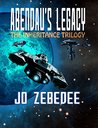
Review::Abendau's Legacy (The inheritance Trilogy) By Jo Zebedee

Abendau's Legacy (Inheritance Trilogy, #3)Abendau's Legacy by Jo Zebedee

My rating: 5 of 5 stars


Abendau's Legacy (The inheritance Trilogy) By Jo Zebedee

I started to write my summary of this novel and decided I needed to read it through a second time. The first two books are done quite well and this, the third, seemed different. I wanted to be certain that it wasn't just me. I don't think it is; but the second time through I was able to pinpoint what was different this time: at least for me.

These characters are growing and developing; which they should do, but that has a larger impact on the third story because of something that I perceived in the first book.

There is a real feeling of dark in the first novel that seems to permeate through from front until end. I'm not sure that everyone who reads it will see that: but I did. It turns out that many of the characters have the darkness embedded within their character; for some through mistreatment in their life that leads to self doubt and their lives become a combination of conflicts that arise within and more often than not this is what drives them. In a small way the protagonists are a group of dysfunctional people with a common purpose and together they muster the ability to complete that purpose.

But their dark lives; the self doubt; the mistreatment; the oppression has led all of them to this moment in their lives, damaged; ineffectual; alone, where their strength comes from working together. But that strength is not enough to keep them from making wrong choices that lead to catastrophe and death for those around them.

In the second novel they still are experiencing the result of bad decisions. Despite that: the characters are showing a slight and slow shift toward growth; but a subtext of the story is that they haven't quite let go of the darker parts of their lives that inevitably drive them toward conflict.

Now in the third novel; the shift that was becoming evident in the second novel has blossomed as though they needed the setbacks in the second novel to help them mature. The characters do remain flawed; but the darker aspects of those flaws have in most case been put aside. They still have some consequences that they must face from past decisions; but those are a given and they seem to have learned from the experience. For Kare there are some new things that have given him even more reasons for self doubt. But all of the main players finally understand the one thing that must happen for all of them to be able to retrieve past victory and make life right for all the worlds in the Empire.

Still unsure of the future, yet more confident of what he's doing Kare sets out to use the forces within the Roamer mesh to defeat his mother; the Empress. [Although most of this is easy to follow in and of itself, I recommend reading the first two books.] Sonly is moving toward becoming president while they seek to dissolve the present Empire. Lichio is beginning to realize that it is now time to begin to acknowledge that he might have a life outside of service to Kare.

When the Empress sends Phelps to retrieving Baelan; so she can punish him, she sets in motion events that will lead everyone to one place where the final conflict must occur.

Jo's trilogy contains elements of world building that comes close to those of Dune though not nearly as dense in narrative yet just as compelling and complex. The characters are a wide array of believable and sometimes relatable people whose lives you care for as you hang onto each struggle; heartbreak; betrayal and each victory; accomplishment; kinship.

Great elements of a blend of Science Fiction and Fantasy with interesting believable characters make this set one of my favorites. And though the darkness that sometimes annoyed me in the first novel seems to have almost vanished, it all makes perfect sense toward the growth and development of the characters and this final book rounds out the trilogy with an exclamation point.

J.L Dobias


View all my reviews

Saturday, May 7, 2016

Review::Teardrops in the Night Sky by J.W. Murison

Teardrops In The Night Sky (Steven Gordon Series,#1)Teardrops In The Night Sky by J.W. Murison

My rating: 3 of 5 stars

Teardrops in the Night Sky by J.W. Murison

My ever increasing love to hate list just keeps expanding. I hesitate to review this novel for a number of reasons. The least of those being that I easily cower from those authors who take umbrage with my views. That much said when I read this I had bias in mind because I always read the 1 star and 2 star reviews and there are plenty of those to go around. I could easily agree with many of those, which is actually unusual, and when I reached the end of the story I had this bad taste while I wondered what I truthfully found wrong with the whole thing. The first thing that comes to mind is that the main character was a Marty Stu--you know that perfect child protegee genius who in this case overcame some really dramatic stumbling blocks to become once again the brilliant and much loved character whose charisma draws everyone eventually on his side while those who are evil are portrayed as the blackest of evil and will never be on his side...which is always the good side. Of course there are some structural problems in grammar and spelling and missing words and homophones, but I won't cover those because I also checked the authors response to those and since he has no personal interest in fixing them beyond sending you to his publisher and I have no interest in sending a list to his 'publisher'. Also the publisher in question is equivocal to self publishing so it's too confusing because the author is really the publisher.

I read this book twice, because I needed to know, before review, what was really wrong. And it's a good thing that I did this, because I learned a lot. I loved portions of this book and even the core idea or theme and I think, despite some of the harsh words, there is enough there to satisfy many readers of science fiction. The main problem for me is the omniscient point of view. That POV in and of itself is not bad, but it does need to be done well to capture the reader and this one didn't do that for me. A problem with omniscient POV is that it lends itself easily to head hopping, which again in and of itself, is not necessarily bad--just difficult to write. Along with that there is both omniscient objective and subjective and it works best for me when author chooses one or the other; and I have this feeling that this work is a blend of both that telescopes in and out of many character's heads. In part the reason for this is that there is a lot of story to tell and a seeming hurry to tell it and not enough time to settle on any particular character. This leads to a feeling that the characters have little if any depth because we keep skimming across the surface while occasionally cutting deep--but the depth is often just for back story for characters and not near enough of that when it happens, especially not near enough for the characters that we need to know and understand.

What this leads to is a whole bunch of misunderstandings; the first being that Stevie Gordon is a Marty Stu. Really: when we examine him he is quite flawed and from a readers standpoint not so lovable. And that begs the question of how these other characters could possible be drawn in toward him. The answers lie somewhere, but not necessarily in the story. What really is Stevie Gordon? Well on the second reading I realize he's very complex. He's that ultra-smart kid who seems to have no common sense; however he also is the one that has ultra smart parents who seem to be well to do, so he's that smart rich kid without common sense. So he does what any one of those types would do and defies authority and steals his friends motorbike and crashes it into a big rig truck and is smashed to the point that his bones and organs are jelly. He survives and miraculously recovers to be a slightly damaged person who functions beyond what anyone could ask under those circumstances. He is no longer the wiz kid he was, but by all rights he should be dead or in a vegetative state. And then more miracles happen and he's restored. Then he turns into an arrogant genius who seems to-for no good reason-despise american politicians and in general the american social political structure. I will grant that he might be bitter because he's been detained because he touched the alien ship and he's in quarantine longer than necessary and we are led to believe it is primarily because of the president of the United States. But when they let him out so he can approach the ship and he is eventually healed of all his injuries and more; he comes out with quite a bit of attitude.

In context this is after Mr. Sales has shot his mother and stranded the second ship with a group of his people and Mrs. Gordon somewhere near Saturn. Stevie is rightfully concerned about this but when confronted with the insistent representatives of the president asking for the alien ship to be returned, his response is thus::


‘You may believe America to be the be all and end all, of civilisation Colonel, but my parents certainly don’t.

Murison, J W (2014-01-24). Teardrops In The Night Sky (Steven Gordon Series Book 1) (Kindle Locations 1706-1707). Grosvenor House. Kindle Edition.

He then goes on some tangent about his traffic accident-for which he was responsible and how the US health care system left his family's funds depleted because they don't have National Health such as exists in Scotland.

That would be a worthy argument if it wasn't for the proviso that the National Health has the authority, in traffic accidents, to recover funds from insurers(no idea what they do with uninsured), from which the circumstance of his injuries might invalidate his argument. But beyond that, this seems to be the basis for his reason to be bitter toward American authority and it just is not enough coming from the spoiled child that caused his own injury.

Then there is this bit right after when Howe tries to argue dominion over the alien ships.


Howe’s head came up, ‘you’re right, I saw what they did to them but these ships landed on American soil and now belong to the United States of America.’

‘Says who?’

‘The president.’

‘Yes of course, God incarnate himself.

Murison, J W (2014-01-24). Teardrops In The Night Sky (Steven Gordon Series Book 1) (Kindle Locations 1721-1724). Grosvenor House. Kindle Edition.

I'll admit the military are getting heavy handed at this point; but Stevie's response begins to reach over the top for very little if any good reason. I will grant again that his concern is for his mother's safety because he has yet to locate the other ship and save her; but his approach is one of taking an end-run around authorities without even trying to negotiate some agreement to help save his mother before portioning out property. The impression the reader is suppose to get is that he has to do it all himself and yet it seems as though he has taken upon himself that only he can do this and in fact eventually his superior attitude leads to the realization that his statement was ironic in that Stevie begins to act like God incarnate.

It might be asked, "Why do I say that?" And that's a fair question. It comes from when Stevie says that the ship has mandated that all countries are allowed access to them and to their technology but then he turns around and when presented with Jim Grey a potential candidate for the crew (and after finding out the man claims he can make atomic bombs) Stevie gives Jim a deadline for making one for him before Jim can join. (As it turns out they will need one or more in the future-that's a spoiler-but at this moment Stevie doesn't know that and he is clearly taking advantage of his authority and frankly it's rather troubling in the very least in the context.

This atomic bomb thing is important for another point later.

Now it can be argued that Mr. Sales who alleges that he works for the president and even the president have demonstrated that they are evil. I won't argue against that. But what we see of Mr. Sales is that he seems to have some grudge against the Gordons and we don't know why because as close as the POV gets to him we don't get that answer. The president himself orders that Stevie be killed, but this is after Stevie makes his inflamatory remarks about the US authority and the president. And my point of contention is not that the president is made to look evil--I see a lot of that in fiction--the point is that there is never a clear motive for it. So we're left to believe that Mr. Sales and the President are both raving lunatics that have gone off the rails and the Gordons have just gotten in their way. And we're expected to understand that that is justification for Stevie's sour attitude about the US in general.

I'm going to skip over the troubling fact that there are a number of times when Stevie runs up against criticism from potential candidates who always too quickly roll over and suddenly see the wisdom of his choices. And somehow suspiciously everyone that is infused with the Nano technology from his ship are suddenly utterly loyal.

What I want to touch next is the character Lewis:: in the author's own words from his blog on goodreads.


Lewis is a specialist that served his in his countries armed forces, who has one of the highest IQ’s on the ship and can build a nuclear weapon from scratch; hardly stereotypical.

Where did he come from though? The idea for Lewis came from watching one of my favourite films the Green Mile. If you have ever seen Michael Clarke Duncan as John Coffey then an image of how I see Lewis should spring straight into your mind.

Sounds good right, well maybe the part about a literary character inspiring a character might be suspect, but the part about the mans intelligence sounds good. The trouble is that the only place in the book that supports that is where Babe (the ship) asserts that he's one of the most intelligent members of the crew. Asside from that, every word out of his mouth suggests otherwise. And this part about the making a nuclear weapon has me stumped, because in this book it was Jim Grey who did that and unless I missed something both times through, there is no place that even suggest that Lewis can do that. But asside from that I question the IQ of Jim Grey for letting himself be bullied into making that bomb in the first place.

I'm giving this book three stars because it does have some great ideas and it's chock full of character's and story, though that's what gets in the way because there is this constant feeling of rush with no clear focus on any characters; despite the feel that Stevie should be the main character. But even what I have shown here is taken out of context and represents at best how I came to have this love hate relationship with the novel and I certainly would expect future readers to come to their own conclusions. The concept of the character Stevie is great but it's shortchanged and overshadowed by a lack of focus. It would be great to have been closer to Stevie's point of view to understand him better because he's a great Übermensch that has a capacity for both great good or evil and is complex enough that he is unable to recognize or admit to his own blindness to his flaw, which is that he's becoming that which he professes to hate the most. Soon he'll think that he's the only one who can police the universe and that everything he does is for the better of mankind.

I've already read the second book and I do recommend reading this one with a few proviso regarding grammar and structure. And of course I'm obviously a bit confused.


J.L. Dobias

View all my reviews