 Odd John by Olaf Stapledon
My rating: 5 of 5 stars
Odd John by Olaf Stapledon
This is my third offering in super human or Ubermensch. These three seem to point to a theme that’s a keystones to later works. The first was The Hampdenshire Wonder by J.D. Beresford and this is actually the second chronologically and the third was Theodore Sturgeon's More Than Human. All three stick with me as three that I encountered in my early reading history. If I were to add more to this I'd add Mary Shelly's Frankenstein which might at least account for a trend that the other three books take.
I read all three when I was in my teens and I think that the negative outlook of Odd John and The Wonder left me at a place where I avoided rereading them. More Than Human has the benefit of some small amount of hope that the Ubermensch might survive. All three still hold the tone set by Frankenstein; in that the super human would look much like a monster to us. To this end there is always some bit of mutation to the physical appearance and some lack of morality in the sense that whatever they might use for morality is something we can't understand.
J.D. Beresford's Wonder was someone who had no peer at the end of his life and he had a lack of a sense of wonder along with his own strange morality. In Odd John we see this at the beginning but John has a longer life and a better chance at coming to terms and perhaps at staving off the sense that there is nothing left to marvel at or be in awe of.
John's physical difficulties are mostly his slow aging process. And we all say, ‘How can that be bad?’ But John is born with an intellect that goes for beyond his age and with the slow growth easily out strips his physical appearance which is doomed to always be well behind his chronological age. At an early age he takes an interest in everything; but specifically politics, and its power and wealth. His physical problems may account for his interest in medicine. And of course he studies theology, philosophy and the sciences.
He eventually saturates and become disenchanted with everything he takes an interest in. He also is becoming aware that there is nothing in modern theology, philosophy and the science that helps explain what he is. Throughout all of this his one anchor is his mother who seems to have some telepathic connection to him and displays some level of understanding of him and his plight.
His eventual conclusion that he'd have to make his own search for others like himself and in turn uncover more about why he exists lead him down a dark path that begins to show the skewed moral sense that he was forming for himself. Once again being the super human with no peer to study and to guide him, John creates his own moral standard based somewhat on the simplest survival characteristics that all humans have. This comes to the forefront while in his teens, when he takes up with a police official named Smithson. He and Smithson become friends and through his usual precocious inquisitiveness John learns much about breaking the law. His intent is to rob from the rich and fund his quest. This works well until Smithson finds him in the act and John has to make a snap decision resulting in the death of his 'friend' Smithson at Johns hand: and knife.
Because the story is told from another friends Point of View this part is told in a frame story from some future time when John finally decides to confide in the narrator as to what was going on at that time in his life. It might not have come up had that friend not thought to mention he had noticed a peculiar change in John at that time. The moral dilemma in this is that John admits that this was mostly a choice of his survival so that he could continue his plan to bring together others like himself in a community that would work for their own betterment. John had at some point given up any notion that they would be able to help present mankind whom he considered to be on the level of an animal such as a pet. This also is a common thread that runs through these types of stories.
This, when compared with the other stories of this nature, might leave the reader wondering if there were not some ingrained fear in man that, given evolution, there would eventually be a higher form of intelligence that might make present man look like a common animal. It seems ironic from there; that the fear is that the higher one would treat us like we treat our pets and then that that carried over to the notion of having a different moral sense that allows them to kill a man under the right circumstances. I had to stop and think about that; is this how we do treat or pets?
Where J.D. Beresford's wonder, Victor Stott, was doomed to be alone and in fact was plagued by another child who looked similar to him but did not have his gift; John has the power of telepathy and through it he finds others like himself and it becomes his life’s ambition to assemble them and found an island colony. Throughout he uses the narrator as his front man for inventions he creates and sells and makes both of them rich. This gives him a great power over the narrator and sometimes it sounds like John abuses him; while at the same time he values the man enough to know that he needs to let him live a somewhat normal life. This probably gives the reader a better picture of John than we have of Victor and the Gestalt of characters in More Than Human.
I think that the Ubermensch in this novel have something that is better than that of J.D. Beresford's Wonder and that is that they never lose that sense of wonder. Yet what makes this particularly dissatisfying is that once again there is no room for both normal man and the super man and a decision has to be made. It's interesting what that decision finally is.
If I have any qualms about this novel it would be the large sections of expository writing that begins to dominate as soon as John reaches that age and stage where he is giving up on mankind. I'd be inclined to believe that he was beginning to reflect the views of Olaf Stapledon; what with the long-windedness of the dissertations.
If you are interested in reading this I'd suggest finding a paper copy. My paper copy from long ago wandered off -long ago; so I used the online e-book, which I think comes from the same source as some gutenburg text that probably was scanned in and only lightly edited. There are numerous obvious problems and some not so obvious that come of that and unless you are a forgiving reader I'd suggest again, find a paper edition.
Theodore Sturgeon's More Than Human comes long after this; yet he uses the same notion of telepathy and a few other evident powers shown in this book. He continues the discussion on morality and how that might differ for the super human. What he does differently in the community of the superior’s, is that he makes them dependent upon each other to form an entire gestalt being.(The lesser parts are not so superior.)
This is a great SFF Classic that still stands well when considering the time it was written and is a novel that should be of great interest to those continuing the conversation about Homo Superior and what that looks like and how they might change or endanger the course of mankind.
J.L. Dobias
View all my reviews
[Rock] : [Paper] : [Kindle (Computer)]

It's that old game: rock; paper; scissors. Which beats which? Of course you might have to establish whether you’re talking about reading or writing. I might go into which is best to read some time later; but for now I want to look at how writing has changed. Notice how I didn't say improved.
I was reading about someone’s experience; they spoke about the advice that the speed of creativity in writing with the pencil or pen and notebook are things that go hand in hand; and that this advice worked for them. I think this type of advice is something that's more personal preference than universal truth. I won't even go into the argument that writing the creative content in your head is the most efficient: and saves trees. Writing onto media puts down into words what's rattling around in someone’s head in a form that might be readily available to the author and perhaps shared with colleagues. Throughout history the media has changed. The purpose might range from fear of forgetting something before they get it down or it might be viewed as a way of preserving information over long periods of time to be used by others. We’ve been doing this since near the dawn of time.
Long ago we used rock. Rock lasts longer most of the time and God wrote on rock with his fingers so there is no shame in using rock unless you're pretending to be God. It's murder on the finger. Then there was the quill and parchment of which parchment didn't last as long as rock and I'm sure there was some discussion about which was faster though not much really, because CNC machines would not be invented for quite some time; otherwise rock would still be in favor. Switching to quill had its advantages: such as, if you ran out of ink there was always blood. But for dissemination of work over a wide area either paper or rock required a lot of time with many hands to make a few copies. Then come printing presses, which were great for wide distribution; but for utility and speed it was easier to drag around, pen and paper.
Then we have the lighter weight typewriter. Nimble fingers and typewriters and precision typing skills would argue that the typewriter was faster than paper and quill and much faster than scratching on a rock. But they were heavy, cumbersome, and awkward;until there were light weight portables and electric typewriters, the market for quill and paper still existed for anyone constantly on the go. And then even the light weight portable typewriters were not as easy to carry as a pen and notebook.
The next big step is the computer. The first one of those was about as portable as a printing press and even the first laptop was a bit heavy though you didn't have to carry a ream of paper; as you would with a typewriter. Now with the tablets and phone apps it’s like having the notebook and pencil or pen and yet saving all the paper, ink, and graphite.
But which is faster for the writer? That was the question.
There's a possibility that most writers don't fall in that highly skilled department when it comes to typing skills. Perhaps hunt and peck or using one of those insanely small keyboards on a phone might add time to the equation. So does that make pen and paper faster?
Not for me.
In fact, using pen and paper has always been counter intuitive for someone like me. My handwriting is atrocious; so much so that I used to use a non electric smith corona for everything. Trying to sort through my notes done by hand are similar to deciphering a strange language etched on a rock. You can call it laziness that my penmanship is poor; and a lot of people did and still do. But the bottom line is that the best method for me to use, for written word, is the computer. As for computers: first drafts, for me; I leave the auto spell checker on, to save me from having to backtrack. Since I know I'll redo everything at least five times before I give it to anyone else, this works despite the insistence of the spell checker to incorrectly alter simple words on the fly. All other edits are with spell checker off.
Does this put me to a disadvantage and slow me down when creating? My hand, my pencil, my pen, my paper, my keyboard and my computer don't think. I do that and the only thing that slows me down is the thinking. When I put it all on paper or in electronic form it takes about the same amount of time and except for my poor handwriting, none of those other pieces of the puzzle seem to be any better than the next, in creating a page from my thoughts. But when my heart gets into it, everything begins to flow out and all I worry about is not having anything at all to put it onto before it starts to fade away like last nights dreams.
So I will take what's available at the moment, paper-and-pen or computer, with the caveat that if its pen and paper some parts might get lost in translation.
As for rocks: the neighbors are happy they took those away from me, because finding them in the living-room amidst all the broken glass was getting annoying.
J.L. Dobias
 More Than Human by Theodore Sturgeon
My rating: 5 of 5 stars
More Than Human by Theodore Sturgeon
This is another of those I read a long time ago and perhaps as much as five years ago someone suggested it as a book that had largely influenced them. I hardly recall it and can only attribute that to the fact I read it over 40 years ago. In rereading it I found some parts of it seemed somewhat disjointed; though maybe just jarred a bit by the change in names for major characters. This might have contributed to my earlier lack recollections of the whole.
Since the novel is three novellas; two of which were written as a sort of sandwich on either side of the original piece 'Baby is Three', that might explain the disjointed feel.
The first part 'The Fabulous Idiot' brings to mind another book I recently read, The Hampdenshire Wonder by J.D. Beresford. The idiot is a 25 year old male who calls himself Lone, who is a street person; because of the telepathic ability he has he is under educated and isolated from others and living well below his potential. This part has another fabulous idiot in the guise of an over protective father who has two daughters. The older daughter has the benefit of having had her mother raise her until the younger was born and at birth the mother died. The insane father has tried to raise both girls in isolation and discourages any close physical contact between them and anyone else. This creates a strange innocence in the youngest, Evelyn; which seems to make her susceptible to Lone’s telepathy, when they manage to stumble across each other. The father eventually finds them together and he beats them both before he ends up killing himself.
After this incident and Lone's long recovery, he isolates himself once more until he meets Janie, a telekinetic, and her two friends Bonnie and Beanie, the teleporters. Eventually they adopt a mongoloid baby who makes the fifth of their curious Gestalt. At this point they are capable of wondrous things; but what Lone does is try to help a friend on his farm by using standard off the shelf parts to create anti-gravity. This is installed on his farmer friends truck just prior to Lone's discovery that his friend has abandoned the farm.
Also of note in this section is the introduction of two other characters Gerry Thompson and Hip Barrows. Gerry is an orphan and Hip is the son of a doctor. Both seem to be gifted.
The Second Part 'Baby is Three' is the original novella that reads like a mystery. Gerry is at a psychiatrists office and is negotiating for therapy with a sizable amount of cash. Based on the previous novella the cash is a big mystery; but considering this from a reader having only this story a larger mystery unfolds as the analysis begins.
Gerry meets Lone who takes him back to his cabin in the woods where he is introduced to the multi-talented Gestalt. Gerry's own talents are similar to Lone's ; but it takes some time to determine this. The real initial crisis of this story is that Lone has died and left specific instructions about what the Gestalt must do for it's continued existence. The larger crisis is that this stipulation has led to Gerry having murdered someone and this therapy is mostly about getting to the center of that.
Yet as the whole unfolds, the real focus is on the way that the Gestalt of five people are so different from the human parts that there is nothing to compare it to and no real reason to believe that all the socio-psychological behavioral patterns of normal humans should regulate them. And possibly when in the Gestalt they have no fair concept of some of the restrictions that regulate humans. No moral compass.
The third story is 'Morality'; taking up after 'Baby is Three' with the notion that the Gestalt is missing something and Hip Barrows shows up as the target of a superhuman being that has no moral compass. This story returns us also to the notion of the Anti-Gravity device that was previously left installed on a truck in the center of an abandoned farm.
This is a great SFF classic that examines once again the notion of evolution and the possibility of a superman. Unlike 'The Hampdenshire Wonder by J.D. Beresford', which is from an outside point of view the reader gets a close up picture of the inner workings of the minds of these characters and that might add to some of the disjointed feel within the story. Where J.D Beresford gives us a rather dark picture and outcome Sturgeon is somewhat more optimistic.
J.L. Dobias
View all my reviews
 Endurance by S.L. Viehl
My rating: 4 of 5 stars
Endurance (A Stardoc Novel)by S.L. Viehl
This is the third offering in the Stardoc Novels and would round out a nice trilogy for those who need to take a break in reading before venturing into the remaining seven. Personally I'd recommend the reader to read the forth book; because some of the major questions that have been lurking in the first three will finally be answered. But probably not all questions.
In the previous book Beyond Varallan our hero Cherijo is stuck between a rock and a hard place and decides the only way to get out of it is to use her connection to the Hsktskt-piratical slavers-to turn the table and pretty much send a whole fleet into slavery. This does not endear her to her own fellows and since she's discovered that almost everyone close to her has betrayed her she's at the furthest end of her rope, while trying to run the slaver's hospital and keep the slaves in good order so they can be sold out to slavery.
This is a novel that digs the furthest into that dark spot where I've defined her relationships as being Schizoid in nature. Despite the torture and near death experiences rife within the story there is still time for romance and Cherijo again finds herself torn between lovers and being pursued by more of those than she cares.
Once again the reader delves into the strange nature of the aliens within this series; but ever more strange is the man known as Reever who is the most perplexing of characters in the series. Yet more perplexing is that Cherijo has such a problem pulling herself away from this horrible person. Even though there might be some justification in Reever's attitude in this story there is a huge stretch of the reader's patience with Cherijo throughout the story. This all works out, somehow, but it becomes quite thin right up to the end.
Lots of surprises in this one and more back-story to take us to the forth novel
Great and Strange SFF for the Fans who like both the Star Wars and Star Trek fiction franchise that is out there. A bit of a stretch often for the purists in SF, but if you do give it a try, you need to read the first four almost as one book to get the full picture of things. Maybe even eventually understand how Cherijo can end up so messed up.
J.L. Dobias
View all my reviews
 The Hampdenshire Wonder by J.D. Beresford
My rating: 5 of 5 stars
The Wonder (The Hampdenshire Wonder)by J.D. Beresford
This is billed as Science Fiction and it is; but the reader is required to endure 50 pages of build up to get to it. Not that that's entirely bad, because the writing is fairly engaging; it's just that sometimes it becomes questionable where the whole thing is heading. There is a sort of feel similar to some Mark Twain story telling that left me looking for the humorous turn of events coming up around the bend. But this is more of a serious piece; once you get past the 25% mark.
There is some justification for the long lead-in. The first is to introduce us to the narrator who first sees Victor Stott, as a very remarkable child, on a train. We then digress to the story of Ginger Stott, Victor's father, and his story. The idea, I suppose, is to start with a national pastime, Cricket in this case, and create the character of Ginger: a self taught Cricket prodigy. When a tragic injury takes Ginger out of the game, he tries to train other players; but finds that they all have formed bad habits and are not trainable to his methods. He decides that the only way to train anyone would be to keep them isolated from the game until they were a teen and then train them from the place of having no previously formed habits.
This leads to Ginger getting married. This happens in much of a manner that looks like-Ellen Mary Jakes, a long time spinster, finds out about Gingers plans and offers herself; to which he responds, "Well! I dunno why not". This union results in one offspring when Ellen who is near her fifties gives birth to a possibly hydrocephalic boy. The boy, Victor, is not expected to live; but surprises everyone. Though he lives; Victory will not carry on the family Cricket legacy. Victor's large head seems to be there to house his higher intellect, because he turns out to be a prodigy in his own way; though this will be difficult to determine, because he hardly ever speaks.
Though in part this story delivers a message about what life might be like for someone who can't have that sense of awe (wonder) that we all have from the world around us and all the marvels of science and philosophy, it is also a window into problems with education; that continue to plague us to this day.
It becomes clear early that at age three or four Victor can absorb all the information from the dictionary, the encyclopedia, the bible and a whole library of books; and that the present education system is geared to drag him down because it's made to accommodate a rather average intellect. That doesn't even account for his rather strange social skills, or what looks like a lack of social skills.
Because the story is told from a viewpoint outside of the prodigy, which makes some sense because one wonders what the inside of the prodigies thought process might look like; it gives the reader a story that seems to revolve around and about the reaction to the prodigy rather than any notion about how the prodigy must feel about things. That leads to our narrator using other people’s thoughts and feelings to try to come up with a picture of what it must be like for the prodigy.
Once you read this you will see that the title of The Wonder or The Hampdenshire Wonder can almost have two meanings and that adds just the right touch to the whole piece.
This is definitely for SFF lovers who don't mind watching the kettle boil or paint dry to get to the interesting parts. Still it does stick in the mind as one of the classics that set the pace for others to follow.
J.L. Dobias
View all my reviews
 Titans by Edward W. Robertson
My rating: 4 of 5 stars
Titans by Edward W. Robertson
I picked up this book along with two others off of a suggestion for reading. Of the three this one was by far the most well rounded story. The story is told from the POV of a main character that has lived for over three thousand years. Living forever of course has its good points and then some few bad points, though I know a few people who might argue that it would be whiny to make a big deal about the bad points of this situation.
But there is one kicker, in that Robert Dunbar will only live forever if he can keep from being mortally wounded and that's a difficult task to undertake for so long. There is no guarantee he won’t spend a great portion of his life as a madman, with his long life driving him insane. Not to mention the tediousness of being placed into slavery.
If there were any qualms I might have with the story, it would be the sometimes somewhat banal language that comes from this man who has had three thousand years to develop a most acerbic attitude toward everything.
Robert is just trying to live his life quietly amongst those who have such a short life when he meets Baxter, a man who knows more about Robert than Robert feels is safe. So Robert’s first reaction is that he needs to kill Baxter. This results in both of them plunging toward death from a hi-rise apartment patio. But Baxter has a few tricks up his sleeve and saves them both. It turns out that Roberts new friend is an AI encased in an android body.
Apparently even to Roberts surprise the corporations of Earth have managed to create viable AIs; but they haven't been able to control them very well. The AI's are hiding in space and are concerned about the corporate movements to go further into space while creating a virtual slave labor force. They also are somewhat concerned about the corporations wanting to recapture the AIs, but the novel seems mostly focused on their attempt to negotiate for better circumstances for the future colonists. To that end they have enlisted Robert from whom they intend to tap great knowledge of history.
From there the story becomes doubly interesting as Robert recalls his past life and in some ways his qualifications to the job, while the narrative examines the current politics of the colonies that exist within the solar system. It's quite well written but I'm not a historian so I wouldn't be much use in trying to validate any of the history in the text, though it flows well and helps develop the character.
The theme of long life has some familiar elements that I've seen in other works of fiction, but the main characters insights and outlook are refreshingly different some times and keep the story moving along.
It's a thoroughly entertaining read that should capture the interest of most SFF fans with a small appeal to the historic fiction lovers. It also almost screams for some sort of sequel; so we'll have to wait and see.
J.L. Dobias
View all my reviews
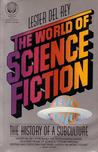 The World of Science Fiction, 1926-76: The History of a Subculture by Lester del Rey
My rating: 5 of 5 stars
The World of Science Fiction by Lester del Rey
Though I would agree that this is not a good source of in-depth analysis of the writing of science fiction I think that it does do what it set out to do and expecting any more is truly expecting too much. The History of a Subculture does not imply that it means to analyze the books or the work of that history in great depth; and if it had the book would have had to have taken up much more room on the shelve by the time the ten volumes were finished.
This is a generalized history of the first fifty years of science fiction starting with the age of magazines and short stories. I highly recommend this book when I run across people bemoaning the fact that short stories have slipped in quality, because they seem to be abandoned by many of the authors that were the backbone of science fiction.
The close analysis and the author's own participation in much of the process lends to a comprehensive examination of what happened in the industry throughout that fifty years and how it gradually led to the acceptance of more novels in science fiction; which in fact did draw many authors away from the short story venue. But far from outright abandonment, this book helps detail many of the problems and struggles of the magazine industry to try to create a proper demand and retain that demand while the growing industry became a hydra-like creature that then falls upon itself like an Ouroborus. More than anything; the industry itself, with its ups and downs was the largest factor in losing the more skilled and prolific authors.
If I have one disappointment about this book it would be that it may have failed in recognizing some of the most prodigious works that stand out as milestones in the industry. In particular I can cite a novel that did not get a mention in this history. That novel was important enough that I felt the possibility exists that, because of the omission, even some pivotal short stories might have been missed. I might have let the novel slide if the whole work were devoted entirely to short stories; but the second half does go into detail concerning novels.
What was conspicuously missing was Philip K. Dick's The Man in the High Castle. This is a book that many say was Philip's greatest achievement and it even garnered a Hugo. Had this been mentioned only, though there were others that had brief summaries and sometimes a limited analysis, I would have been happy. But this wasn't even mentioned despite the mention of Philip K. Dick in the short story section. Because of that I realized there might be several other works by other short story writers that could bear mentioning and were passed up. I'm not sure why that is; but that still makes me wonder about whether all the more important short stories were covered, since short stories are not something I ever read in large amounts.
Still this book, despite that one misgiving, stands well as a window into the industry and the people (editors) who figured prominently in creating the consistent feel and encouraged writers to hone their writing skills. It also shows how in the boom times they had to deal with other less stringent publishers and editors who were trying to get a piece of the pie without the work. It carefully details how these late comers consistently destroyed themselves and often a few of the established magazines in the process before recovery was possible.
This book goes on the shelf right next to my two volumes Robert Heinlein biography.
This is a great reference piece that might even have a few good suggestions in reading for die hard SFF fans.
J.L. Dobias
View all my reviews


